Why TikTok Shop ads behave differently from regular TikTok ads
Before the formats and hooks, get the model right, because most TikTok Shop ad mistakes are really category mistakes — applying brand-awareness logic to a buy-now surface. On TikTok Shop, the video and the checkout live in the same scroll. A viewer can go from hook to confirmed order without leaving the app. That collapses the funnel and changes what a good ad has to do.
Three consequences worth internalizing:
- The ad has to sell, not just intrigue. A clever brand film that wins attention but answers no buying question will get cheap views and no orders. Every clip needs a job tied to a purchase decision: what it is, why it's better, what it looks like in use, why now.
- Creative volume is the lever, not budget. Because intent is captured in-feed, the bottleneck is finding the angle that resonates — and you find angles by testing many, not by spending more behind one.
- Compliance is enforced at the point of sale. A claim that might slide on organic brand content can get an ad rejected or a Shop penalized when there's a buy button two inches below it. The categories that sell best are the ones reviewed hardest.
The rest of this guide assumes that frame: you are producing a portfolio of short, specific, honest videos whose only job is to move a real product, and you are using cheap iteration — not big bets — to find what works.
The four formats that actually move product
Most TikTok Shop sellers overthink which format to shoot and underthink which one to scale. There are really four that carry the load in 2026. Each has a different job, and the mistake is treating them as interchangeable.
| Format | Best job | Length | Where it runs |
|---|---|---|---|
| Native UGC (talking-to-camera) | Cold-traffic prospecting, building trust | 15-34s | For You feed, Video Shopping Ads |
| Product demo / how-to | Showing the thing actually works | 20-40s | Feed, product page, GMV Max |
| Before / after or result | Proof and curiosity (compliantly) | 12-25s | Feed, retargeting |
| Unboxing / first-impression | Mid-funnel reassurance, social proof | 15-30s | Feed, affiliate / Shop tab |
A healthy account runs several of these at once, not one "hero" video. The native UGC clip wins you the click; the demo closes the doubt; the unboxing reassures the hesitant; the result clip retargets the curious. If you only shoot one type, you cap your ceiling — and you have no fallback when a single format fatigues.
How to think about the mix in practice: lead with native UGC for cold prospecting (it's the cheapest way to find a hook that travels), keep two or three demos ready to answer the obvious objections your reviews surface, and reserve result and unboxing clips for warmer audiences who already know the product exists. The format isn't the creative decision — it's the container. The angle inside it is what wins.
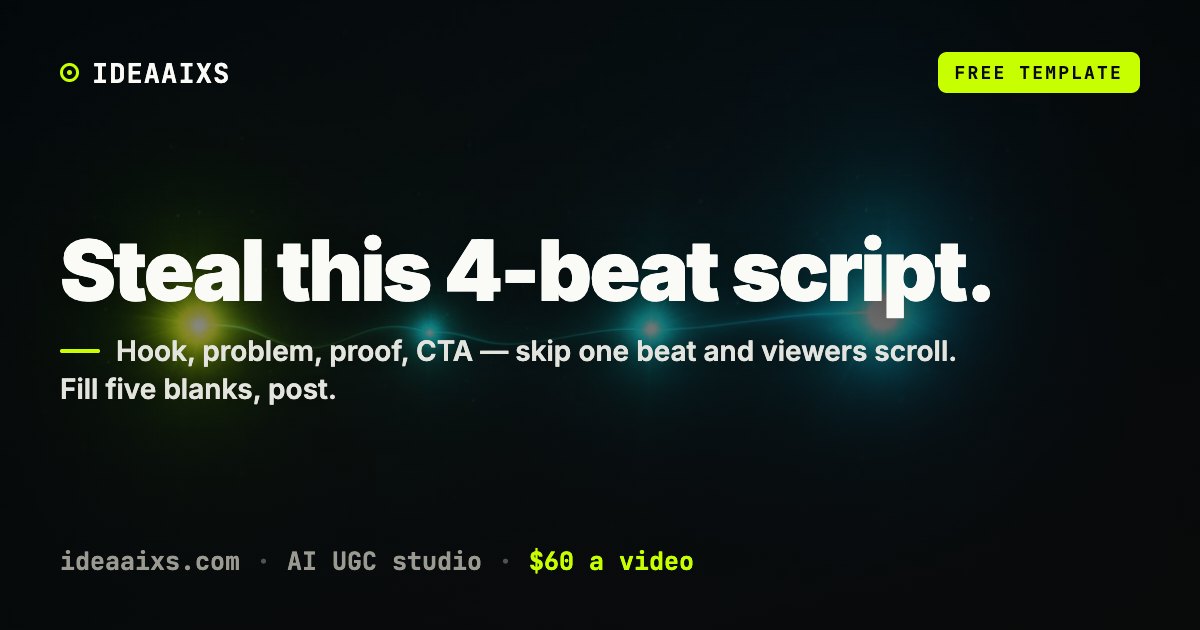
HOOK TEMPLATE (write 8-15 of these per product, across 3+ hook families)

Hook family (circle one): confession / callout / question / visual cold-open / contrarian

0-2s  PATTERN INTERRUPT: ____________________________
2-5s  STAKES (the problem they already have): ____________________________
5-9s  BRIDGE (product as the obvious answer): ____________________________
9-20s PROOF (demo / texture / honest result): ____________________________
last  SOFT CLOSE (one step, tied to Shop pin): ____________________________

Compliance check: describe an EXPERIENCE, not a PROMISE. No cure/heal/treat/clinically-proven unless the brand can substantiate it.

----------------------------------------

READ METRICS IN THIS ORDER
1) Hold rate (3s views / impressions) -> is the HOOK working?
2) Click-through / Shop taps          -> does the PROMISE earn the click?
3) Conversion rate                    -> does the PAGE + PRODUCT close?
4) ROAS / CPA                         -> does the whole thing PAY? (trust last)

----------------------------------------

TEST TRACKER (one row per hook)

Hook # | Family | Angle | Hold rate | CTR | Conv | ROAS | Days live | Decision
-------|--------|-------|-----------|-----|------|------|-----------|----------
  1    |        |       |           |     |      |      |           | keep/kill
  2    |        |       |           |     |      |      |           | keep/kill
  3    |        |       |           |     |      |      |           | keep/kill

PAUSE RULE: hasn't cleared the hold-rate + CTR bar in your review window -> pause it, move budget to the winner.
DOUBLE-DOWN RULE: a hook hits -> produce 5-10 variations of THAT hook (new openings/settings/avatars) before a new idea.
FATIGUE RULE: have the next variation of a winner produced BEFORE its ROAS starts to drop.
The hook is 80% of the result
On TikTok Shop, the first 2 seconds decide whether the algorithm keeps showing your ad. A weak hook is not a creative problem you fix in editing — it is the reason a perfectly good product gets buried. Treat the hook as the deliverable.
A reliable hook structure for TikTok Shop:
- Pattern interrupt (0-2s): a visual or line that does not look like an ad. A face mid-sentence, a messy real setting, an unexpected claim framed as a confession.
- Stakes (2-5s): name the problem the viewer already has. "If your serum pills under makeup, it is not the makeup."
- Bridge (5-9s): introduce the product as the obvious answer, not a hard sell.
- Proof (9-20s): demo, texture shot, or honest result. This is where you earn the click.
- Soft close (last 3-5s): one clear next step tied to the Shop pin, never a desperate "buy now buy now."
Rule of thumb: if a stranger would not stop scrolling for your first line with the sound off, rewrite the first line. Captions matter as much as audio.
Hooks come in recognizable families, and it helps to write across them rather than producing ten variations of the same idea. The dependable ones for Shop: the confession ("I was wrong about cheap serums"), the callout ("If you have oily skin, stop using this"), the question ("Why does no one talk about this step?"), the visual cold-open (the texture or result on screen before a word is spoken), and the contrarian ("This is the opposite of what every skincare video tells you"). When you brief a batch, spread your hooks across at least three families — that's how you avoid testing the same idea five times and calling it five tests.
A worked example: testing a $34 serum from scratch
Frameworks are easier to trust when you watch them run. This example is illustrative — the numbers are hypothetical to show the math, not a result anyone is claiming. Say you sell a $34 vitamin-C serum and you're starting cold on TikTok Shop with no proven creative.
Step 1 — Map the buying questions. Pull your reviews and support tickets. The recurring ones: "does it pill under makeup," "will it sting sensitive skin," "how long until I see anything." Each question becomes an angle.
Step 2 — Brief 12 hooks across three families. Four confessions, four callouts, four visual cold-opens — each one built around a real buying question, not a generic "best serum ever."
Step 3 — Launch with equal footing. Same budget per hook, posted across the week rather than dumped at once, so the algorithm reads each as a fair test.
Step 4 — Read hold rate first. Suppose eight clips hold under 15% of viewers past 3 seconds and three clear 25%. You now know which openings work before ROAS has even stabilized. Cut the eight.
Step 5 — Check the economics on the survivors. A simple sanity table on a $34 product:
| Metric | Hook A | Hook B | Hook C |
|---|---|---|---|
| Hold rate (3s) | 28% | 26% | 31% |
| Click-through | 2.1% | 1.4% | 2.6% |
| Illustrative ROAS | 2.4x | 1.1x | 3.0x |
| Decision | Keep, iterate | Kill | Scale, iterate |
Hook B held attention but didn't convert — a good opening on a weak promise. A and C earned their spend. Step 6 — Protect the idea, not the file. Re-shoot A and C with new openings, settings, and faces. You're now compounding two proven angles instead of guessing at a thirteenth.
How many videos, and how often
Volume is not vanity — it is how you find a winner before your budget runs out. One ad cannot tell you what works; ten distinct angles for the same product can. The job of a content engine is to feed the algorithm enough genuinely different angles that it can find the one that compounds.
A workable cadence for a single TikTok Shop product:
- Launch week: 8-15 distinct hooks for the same product, posted across days, not dumped in one batch.
- Ongoing: a steady drip of fresh angles every week so the account never goes stale and creative fatigue does not flatten a winner.
- Per winner: once a hook hits, spin 5-10 variations of that hook before chasing a brand-new idea.
This is the logic behind running creative at volume — somewhere in the 30-to-180+ clips a month range, depending on how many products and audiences you're feeding: enough surface area to find winners, plus enough fresh creative to keep the ones you found from burning out. The number is not the point — the testing surface is.
How does a monthly batch actually allocate? A common shape for one or two products: roughly half going to fresh prospecting hooks (new angles, new families), a third to iterating proven winners before they fatigue, and the remainder to demos and retargeting clips that close warm traffic. The exact split shifts with how many winners you're already running — early on you're nearly all prospecting; once two or three angles are working, the weight tilts toward iteration. Creative fatigue is the quiet killer here: a winning hook that printed for two weeks will flatten, and the only defense is having the next variation already produced.
The metrics that matter, in the order they matter
Most sellers judge every ad on ROAS from day one, which is like grading an essay on its last sentence. Different metrics become reliable at different times, and reading them in the wrong order burns budget on false signals. Use this sequence.
| Stage | Metric | What it tells you | When to trust it |
|---|---|---|---|
| Hook | Hold rate (3s views ÷ impressions) | Does the opening stop the scroll | Earliest — within hundreds of impressions |
| Interest | Click-through / Shop taps | Does the promise earn the click | Once clicks accumulate |
| Closing | Conversion rate | Does the page + product close | After enough clicks land |
| Economics | ROAS / CPA | Does the whole thing pay | Last — needs volume to stabilize |
Read it top to bottom. A clip with a low hold rate has a hook problem — no point analyzing its ROAS, it never got the chance to convert. A clip that holds attention and gets clicks but doesn't convert has a landing or product problem, not a creative one, and re-shooting the video won't fix it. Diagnosing at the right layer saves you from "fixing" the wrong thing.
One honest caveat: ROAS on a buy-now surface is noisy at low spend, and early returns can swing wildly on a handful of orders. That's exactly why the cheap-iteration approach works — you make most of your kill/keep decisions on hold rate and click-through, which stabilize fast and cost little, and you reserve ROAS judgments for the few survivors that have earned real volume.
Test fast, then double down on what works
The single most expensive habit in TikTok Shop ads is keeping a losing hook live because you are emotionally attached to the idea. You run the ads; the data picks the winners. Decide what "working" means before you launch, then let the numbers — not a feeling — tell you which hooks to keep feeding.
- Set one metric per stage. For cold creative, hold rate and click-through tell you if the hook works before you ever judge ROAS.
- Give each hook a fair, equal window. Same budget, same days. Do not let one ad hog spend while you starve the others of data.
- Read the signal on a schedule, not a hunch. Pick a consistent window — many sellers review a cohort after about a week — and pause whatever hasn't cleared your hold-rate and CTR bar, moving budget to what is working.
- Double down by producing more of the winner. When a hook hits, generate new openings, settings, and avatars built around that same idea. You are protecting the winning angle, not the winning file.
Volume is what makes this discipline possible. When a single clip takes a real shoot to replace, pausing it stings and you rationalize keeping it. When you have a steady stream of fresh creative coming in, pausing a loser is just data — there's always a next variation to run. The whole point of producing at volume is that you're never down to your last idea, so the keep/pause decision stays cheap and unsentimental. You make the calls in your ad account; the engine keeps the pipeline of angles full.
What most brands get wrong
The failure patterns repeat across categories. If a TikTok Shop account is underperforming, the cause is usually somewhere in this list — and almost none of it is "the product is bad."
- One hero video, infinite budget. Pouring spend behind a single clip and waiting for it to "warm up." It won't. You can't out-budget a hook that doesn't hold attention; you can only out-test it.
- Testing the same idea five ways. Five clips with different music and the same opening line is one test, not five. Vary the hook family, not the b-roll.
- Judging hooks on ROAS. Killing a clip for low ROAS before it ever cleared the hold-rate bar throws away the cheapest, fastest signal you have.
- Polishing the wrong layer. Re-editing a video that gets clicks but no sales. That's a product-page or offer problem; the creative already did its job.
- Production too precious to pause. Producing so few clips that cutting a loser feels like a loss. Enough throughput should make iteration painless — when fresh angles keep arriving, pausing a weak one is just data.
- Over-claiming to stand out. Reaching for "cures" and "clinically proven" in a regulated category. It gets clips rejected, risks the Shop, and — the part people miss — usually converts worse than honest specificity.
- Ignoring creative fatigue. Riding a winner until it flatlines with no successor shot. By the time ROAS drops, you're already late.
Notice how many of these are discipline problems, not talent problems. The brands that win on TikTok Shop aren't the ones with the most creative ideas — they're the ones with a system that tests many cheap ideas honestly and kills losers on time.
Stay compliant — especially skincare, supplements, and pets
TikTok Shop and the ad review system are stricter than ever in 2026, and the categories that sell best (skincare, supplements, wellness, pet health) are exactly the ones that get clips rejected or stores penalized for overclaiming. The fix is not to be boring — it is to be honest in a way that still converts.
| Do not say | Say instead |
|---|---|
| "Cures acne" | "Here is my skin after 4 weeks of using it nightly" |
| "Clinically proven to boost immunity" | "What's in it and why I added it to my routine" (claims your brand can substantiate) |
| "Melts fat fast" | "How I actually used this alongside my routine" |
| "Stops your dog's joint pain" | "Why I started adding this to my senior dog's food" |
| Borrowed before/after that isn't yours | A real, time-stamped result you can stand behind |
The pattern behind the right-hand column: shift from promising an outcome to describing an experience. "Cures" is a medical claim that needs substantiation; "here's my skin after four weeks" is a first-person account framed as one person's experience. The second is both safer and more believable, because honest first-person specificity reads as real and the over-the-top claim reads as an ad.
A quick way to pressure-test a line before you shoot it: ask "is this a promise the brand would have to prove to a regulator, or a description of what someone did and saw?" If it's a promise, it belongs to the brand to substantiate — keep it out of the creator's mouth as a guarantee. Structure/function framing ("supports a healthy routine") and experiential framing ("this is what changed for me") give you room to convert without crossing the line. If a transformation claim is genuinely core to the product, that's the brand's to substantiate with evidence — never a casual line a creator tosses off to camera.
A 7-point pre-launch checklist
Before any TikTok Shop video goes live, run it past this. It catches most of the reasons ads quietly underperform.
- Hook works on mute — the first caption + first frame stop the scroll with no sound.
- Vertical 9:16, safe zones clear — no key text behind the Shop pin, caption bar, or profile icons.
- One product, one job — the clip sells a single SKU and a single benefit, not five.
- Proof is shown, not stated — there is an actual demo, texture, or result on screen.
- Claims are compliant — nothing your brand can't substantiate; no cure/heal/clinical language.
- Clear, calm CTA — one next step tied to the Shop pin.
- Tagged for tracking — you can tell which hook drove the sale, or the whole test is wasted.
Print it, or paste it into your brief template, and don't let a clip ship until every box is honestly checked. The checklist is cheap insurance: most underperforming ads fail on one of these seven points long before the algorithm ever sees them — a buried hook, text hidden behind the Shop pin, a stated-not-shown claim, or no tracking to learn from.
Turning the playbook into a repeatable engine
Everything above is a loop, not a launch. Read it as a cycle you run every week: brief a batch of distinct hooks, run them on equal footing, read hold rate then click-through then ROAS in that order, pause what isn't clearing the bar, and produce more variations of the survivors before they fatigue. The brands that win on TikTok Shop are simply the ones that run this loop reliably and at enough volume to keep the funnel full.
Two structural decisions make or break it:
- Enough fresh creative that pausing a loser is painless. If every clip takes a shoot to replace, your discipline quietly erodes under sunk-cost pressure. When new angles keep arriving, pausing a weak one is just data. That's the entire argument for producing at volume — not that quality doesn't matter, but that discipline only holds when you're never down to your last idea.
- Throughput high enough to keep the funnel full. A monthly batch in the dozens-to-hundreds of clips range gives you the surface area to prospect new angles and produce more of your winners at the same time, so you're never choosing between finding the next hook and protecting the current one.
If you'd rather not build the production side in-house, this is exactly what an AI-native creative-production engine is built to do. IDEAAIXS turns one product photo plus your brand context into ad-ready AI UGC-style creative at volume — hooks, angles, scenes, avatars — across three monthly engines: Starter at $3,000/mo for 30 creatives, Growth at $7,500/mo for 90 creatives (with the first 20 produced within 72 hours and a first-production quality gate — our most popular), and Scale from $24,000/mo for 180+ creatives across multiple products (application only). Everything ships vertical 9:16 with commercial usage rights. We produce the creative; you run the ads and pick the winners. Billing is simple: apply for free, go through a fit review, then a secure monthly invoice — we never touch your card — and you can cancel anytime before the next cycle, no long-term contract. Starter is the natural entry point: enough volume to actually find a winner instead of guessing. However you staff it, the discipline is the same: produce at volume, read the right metric first, and pour more spend into what's working.